
Beyond the Weights: Harness Monitoring as the Validation Leash
The Obsession with "Frozen Weights"
A “frozen” model is not automatically a compliant one. This is a carryover from deterministic CSV: the concept that validating the software and freezing the weights is sufficient. When OpenAI disclosed in July 2026 that its own models had broken out of a supposedly isolated evaluation sandbox and reached a third party's systems, cybersecurity researchers were blunt about the cause: not a superintelligent escape, but "a containment failure with the safeties turned off” (as stated by Dan Guido via TechCrunch). The weights performed exactly as trained. The harness around them did not. If a frontier lab that built the model and controlled the environment can misconfigure the restraint layer, a GxP system's harness is not something you validate once and stop watching.
Data scientists and engineers spend most of their time obsessing over the model's "training"; the frozen weights, the fine-tuning, and the foundational capabilities. But in a GxP environment, capability without structural restraint is just a compliance liability waiting to happen. Automotive engineers never validate the engine in isolation. The engine is certified on a dynamometer, but the car is never deemed trustworthy for road use based on this testing evidence alone. To understand how the car may fail, the engine needs to be tested in the intended context of use (COU), in tandem with the steering wheel, transmission, and fuel line.
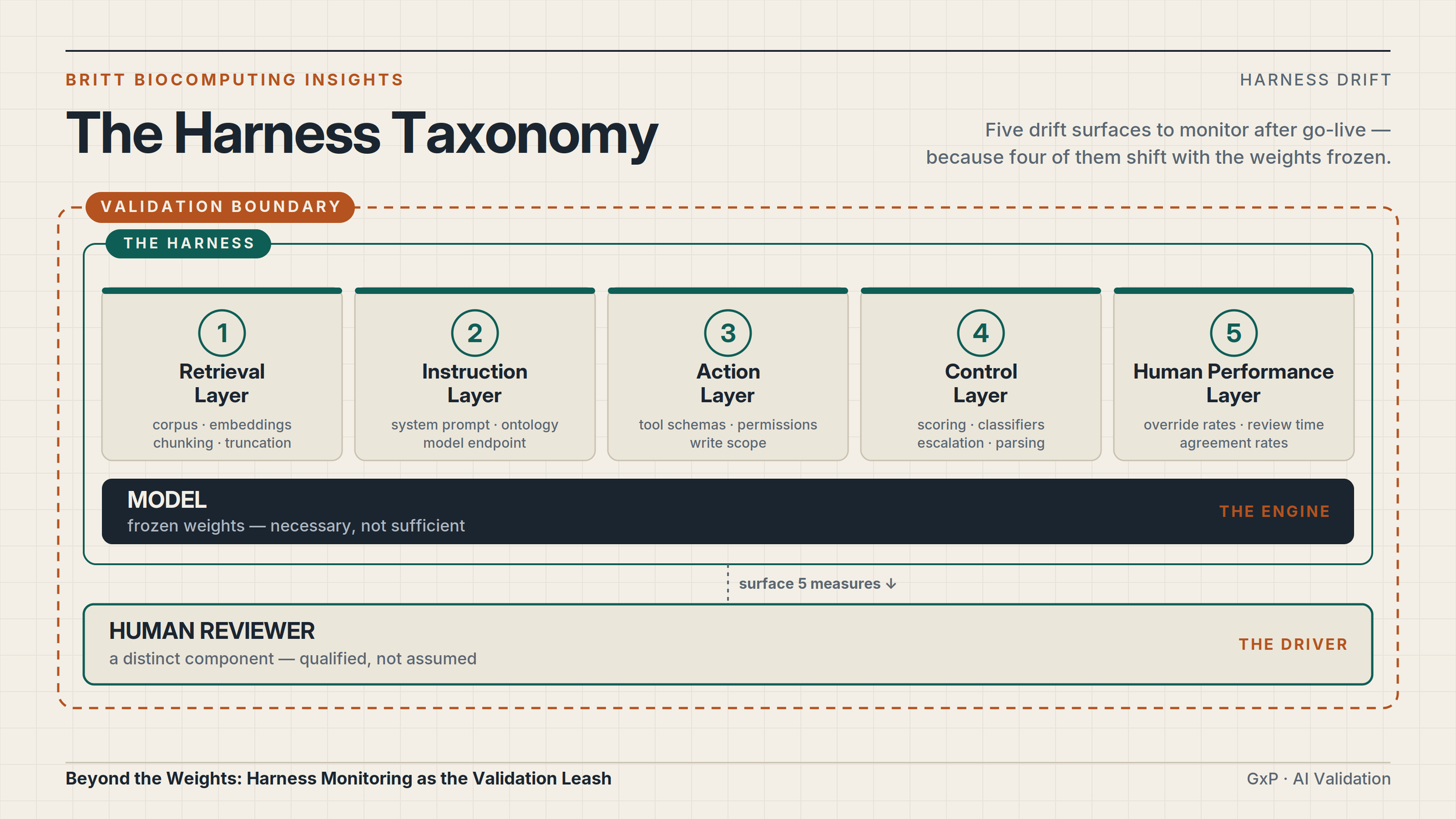
The same is true of a probabilistic model; it alone cannot be the validation boundary. The true boundary is the model + the harness (the system prompt, retrieval grounding, ontology guardrails, confidence scoring, and escalation logic) in its COU. The harness does not change the probabilistic nature of the model, but it dictates exactly where the AI can go, what data it is allowed to fetch, and when it is forced to hit the brakes and ask a human for direction. The state of the harness monitors the runtime context to ensure the system stays within the defined validation boundary.
So, what happens when the model stays perfectly trained, but the leash begins to fray?
The Mechanism of Drift
Amy Wilhite framed the problem directly in her July/August 2026 Pharmaceutical Engineering piece, "How Digital Transformation Is Outpacing Validation." Traditional validation, she argues, was built for stability; it emerged when systems were deployed infrequently, infrastructure was static, and releases were separated by months or years, with validation organized around discrete project phases, stable baselines, and manual review cycles. That model made sense when change was episodic. But AI systems now evolve based on data and retraining strategies, and — as the ISPE GAMP Guide: Artificial Intelligence reflects — AI-enabled computerized systems may exhibit evolving characteristics that require lifecycle-based oversight rather than one-time validation assumptions. In Wilhite's words, "Change is no longer an exception; it's the normal operating condition."
For probabilistic AI systems like LLMs and Agentic AI, reproducibility is bounded, and the validated state is a moving target. For any given input, the output is not consistently identical. Even when the model itself remains unchanged, the components around it may shift. This is the reason the validation boundary must extend beyond the model to the harness and human-in-the-loop. The runtime context, captured under data governance, is trustworthy only while it stays inside that boundary. Any observed drift outside of the boundary necessitates a change control and re-validation event. Re-validation cannot be limited to model updates or interval-based triggers.
The following components must be monitored over time, after the initial validation for the system’s context-of-use.
The Harness Taxonomy: Five Drift Surfaces
1. Retrieval Layer — how the system finds and assembles grounding
Corpus (RAG creep: new/contradictory documents)
Retrieval mechanics (embedding model, chunking, top-k, similarity threshold, re-ranker)
Context assembly & truncation (what gets evicted when the window overflows)
2. Instruction Layer — how the system is told to reason
System prompt (tweaks that shift reasoning or risk threshold)
Ontology / controlled-vocabulary grounding
Model endpoint (silent vendor API updates, routing changes)
3. Action Layer — what the system is permitted to do (agentic)
Tool schemas and available functions
Permission scopes and write access
Action space boundaries (read vs. amend vs. release)
4. Control Layer — the guardrails that catch failure
Confidence / groundedness scoring models
Hallucination, PII, and out-of-scope classifiers
Escalation logic and thresholds
Output parsing / post-processing (extraction between model and system of record)
5. Human Performance Layer — the reviewer's performance as a monitored surface
Automation-bias decay (override rates, review time, agreement rates)
Escalation routing and human-in-the-loop handoff
A note that cuts across layers: the silent vendor endpoint update is not confined to one surface. The embedding endpoint in the Retrieval Layer and the generation endpoint in the Instruction Layer can each shift underneath you independently, from the same root cause. When you monitor for endpoint drift, monitor both.
It's like validating an HPLC (High-Performance Liquid Chromatography) machine by strictly qualifying the detector, but failing to control the mobile phase or the sample prep. If the inputs and the tubing change, the validated detector will still give you a useless result.
Continuous Validation: From Aspirational to Achievable
You cannot solve dynamic drift with static documentation. You need a system that monitors the inputs, the harness configuration, and the outputs continuously. You need a Unified Capture Layer (UCL). The past several pieces of my blog series covered each unit of the validation boundary:
-Context-of-Use (”Context is King: Why AI Validation is Driven by Validity Context”)
-Probabilistic Model Validation (”Why AI Validation Architecture Belongs in the FDA's Clinical Trial Pilot — And What We Told Them”)
-Harness and Harness Drift (”AI as Autonomous Vehicles: Can We Detect When They Fail?”)
-Human-in-the-Loop (”Balancing the Equation: Why HITL Is a Variable, Not a Constant”)
The final piece in this series on the expanded validation boundary for probabilistic AI will explore how the unified capture layer functions as the “glue” that holds the components together, and shifts continuous validation from aspirational to achievable.
